California EV Rebate MyFirstEV: How Automakers and Dealers Can Turn $3,500 Into Instant EV Sales
July 21, 2026 · Peter Glenn
Updated August 4, 2026: MyFirstEV officially launched on August 3, 2026. This post has been refreshed with launch details from CARB and the State of California.
When the federal EV tax credit ended in September 2025, EV sales fell 46% the very next quarter — and new EV sales have stayed down through the first half of 2026, even with gas prices climbing.
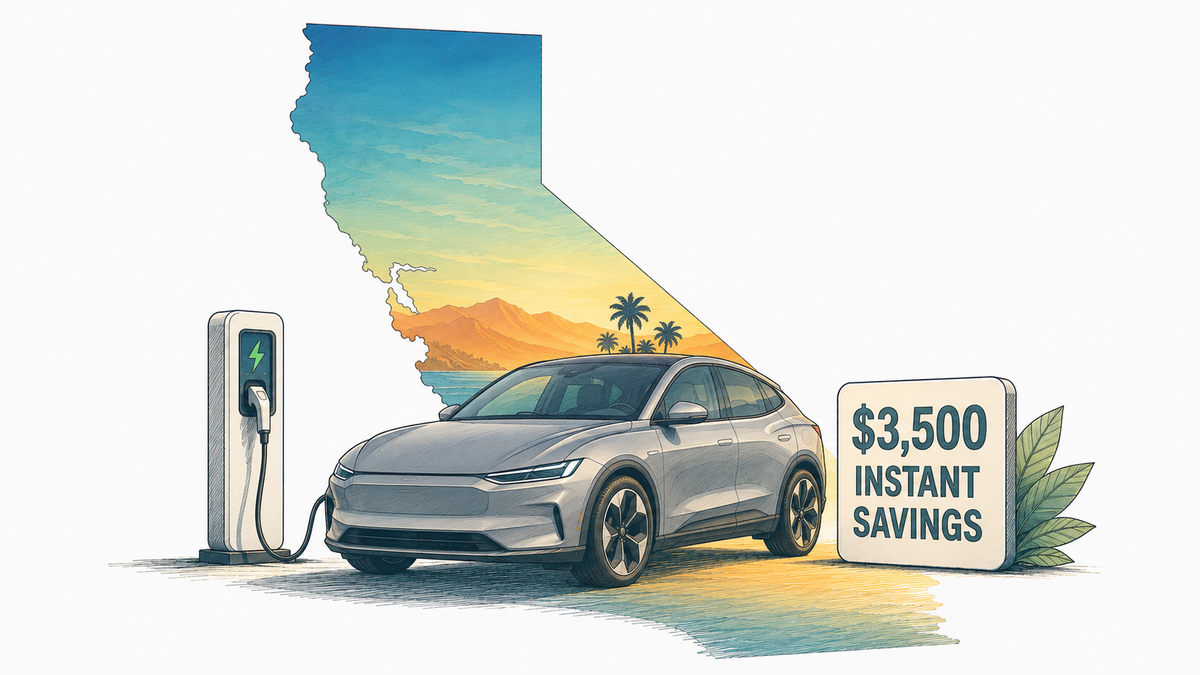
California just delivered the strongest answer yet — and as of this week, it's live. On July 13, Governor Newsom signed SB 168, creating the California EV rebate, MyFirstEV — $3,500 in instant savings for any Californian buying or leasing their first EV. On August 3, 2026, the program officially launched in the largest EV market in the country.
This guide is for automakers and dealers who want to turn the California EV rebate into more EV sales: what the rebate pays, how the launch works, how it stacks — and how EV Life's tools put shoppers' full savings in front of them now that it's live.
What Is the New California EV Rebate?
The new California EV rebate — officially named MyFirstEV — is the state's instant point-of-sale rebate for first-time zero-emission vehicle buyers:
- $3,500 off new EVs with an MSRP up to $50,000
- $1,750 off used EVs priced up to $25,000 — sold through manufacturers' pre-owned vehicle programs
- Open to any Californian buying or leasing their first zero-emission vehicle
- Applied instantly at the dealership, built into the sales process — no waiting on a rebate check
Note that leases qualify — shoppers' lowest-commitment path into an EV just got $3,500 cheaper.
Which Automakers Are Participating in the California EV Rebate?
Thirteen automakers have signed on, per the Governor's July 16 announcement, each matching the state's $135 million dollar-for-dollar — $270 million in combined savings. But they're not all launching at once. CARB's official list of participating manufacturers shows a staggered, brand-by-brand rollout:
- Launching August 2026: Chevrolet, Ford, Hyundai, Kia, Lucid, and Tesla
- Launching September 2026: Honda, Lexus, Subaru, and Toyota
- Launching November 2026: Mitsubishi
- Coming soon: Nissan, Rivian, and Volvo
Launch timing per CARB as of August 4, 2026. Each automaker will publish its eligible models and trim levels on its own website.
A special MSRP waiver applies to California-headquartered ZEV companies: the law waives the $50,000 price cap for Rivian and Lucid, so their vehicles qualify at any MSRP.
The staggered rollout raises the stakes: six brands — Chevrolet, Ford, Hyundai, Kia, Lucid, and Tesla — are live in August, while the rest wait a month or more. With $270 million in first-come, first-served funding, the August brands get first crack at every first-time EV buyer in California.
The California EV Rebate Is Live — But Not at Every Dealership Yet
MyFirstEV officially launched on August 3, 2026. But there's a critical catch for retailers and shoppers alike: launch and availability vary by automaker and dealership. Per the State of California, vehicles ordered or purchased before a participating automaker has made the incentive available will not receive the incentive — there's no retroactive credit.
That makes activation timing a competitive weapon. The brands and dealers who switch on the incentive — and surface it in their digital retail experience — first will capture first-time buyers that slower rivals lose.
And the window may be short: the incentive is offered first come, first served, only while funding lasts. California New Car Dealers Association Chairman Jessie Dosanjh expects the funds to be exhausted within a few months of release. First-come, first-served money rewards the retailers whose digital experience is ready on day one — and day one is here.
Can Shoppers Stack the California EV Rebate?
Yes — and this is where most retail experiences leave money on the table. CARB confirms MyFirstEV can be stacked with other CARB and non-CARB vehicle incentive programs.
On new EVs, the $3,500 rebate stacks with home charger rebates, local incentives, and income-qualified programs like Clean Cars 4 All — worth up to $12,000 toward an eligible EV for qualifying households, plus up to $2,000 for charging — and the Driving Clean Assistance Program.
On used EVs, the stack gets even richer: the $1,750 rebate combines with $1,000 to $4,000 in used EV rebates from investor-owned utilities — rebates roughly 90% of California customers already qualify for. Do the math for a first-time used EV buyer in the right ZIP code: $1,750 at the point of sale plus up to $4,000 from their utility is up to $5,750 before charger support. That's the difference between a shopper seeing "up to $1,750" on a banner and seeing their number on your vehicle page.
Qualification rules shift frequently, and income limits and price caps apply. Visit each program's website for complete eligibility details.
Don't Leave Used EV Sales on the Table
Used EV sales are already up 20% year-over-year as off-lease models flood the market — and the $1,750 rebate runs through manufacturers' pre-owned programs, putting CPO inventory at the center of the program. For the 13 participating brands and their dealers, that's a rare alignment: a state incentive purpose-built for CPO EVs, a first-time-buyer audience they're perfect for, and a lease-return pipeline ready to feed it.
California EV Rebate FAQ
When did the California EV rebate start?
MyFirstEV launched August 3, 2026, but availability rolls out brand by brand: Chevrolet, Ford, Hyundai, Kia, Lucid, and Tesla launch in August 2026; Honda, Lexus, Subaru, and Toyota in September; Mitsubishi in November; Nissan, Rivian, and Volvo are "coming soon" per CARB. Shoppers should confirm their brand has activated the incentive before purchasing, since vehicles bought before activation don't qualify.
Do leases qualify for the California EV rebate?
Yes. The MyFirstEV rebate is open to any Californian buying or leasing their first zero-emission vehicle.
Can the California EV rebate be combined with other EV incentives?
Yes. On new EVs, it can stack with income-qualified programs like Clean Cars 4 All, plus home charger rebates and local incentives. On used EVs, it stacks with $1,000 to $4,000 in investor-owned utility rebates (used EVs only) that roughly 90% of California customers already qualify for — up to $5,750 combined.
How is the California EV rebate applied?
Instantly at the dealership, built into the sales process — the discount comes off the price at the point of sale, with no waiting on a rebate check.
Which vehicles are eligible for the California EV rebate?
Zero-emission vehicles from the 13 participating automakers — new EVs with an MSRP up to $50,000 (waived for Rivian and Lucid) and used EVs up to $25,000 through manufacturers' pre-owned programs. Each automaker publishes its eligible models and trim levels on its website.
How EV Life Turns the California EV Rebate Into EV Sales
EV Life's savings tools are live today on Hyundai, Genesis, Nissan, and Mercedes-Benz retail sites, powered by an Incentives Engine tracking 500+ incentives across California and the United States. Now that the California EV rebate is live, it flows into every calculator we power — automatically. Our calculators also show shoppers their fuel and maintenance savings versus gas vehicles — especially compelling with gas prices at all-time highs. And it works: real-time incentive and savings calculations increase EV calls to action and EV dealer lead generation by over 20%.
With funding first come, first served, every day a shopper can't see their full savings is a day of lost sales.
⚡ Book a demo to start driving California EV Rebate sales.
Data on our site is for informational estimates; actual incentive amounts may vary. Program details reflect official CARB and State of California guidance as of August 4, 2026, and are subject to change — we'll keep this post refreshed as new details are published.